We Audited 56 Treasure Coast Business Websites: Here's What We Found
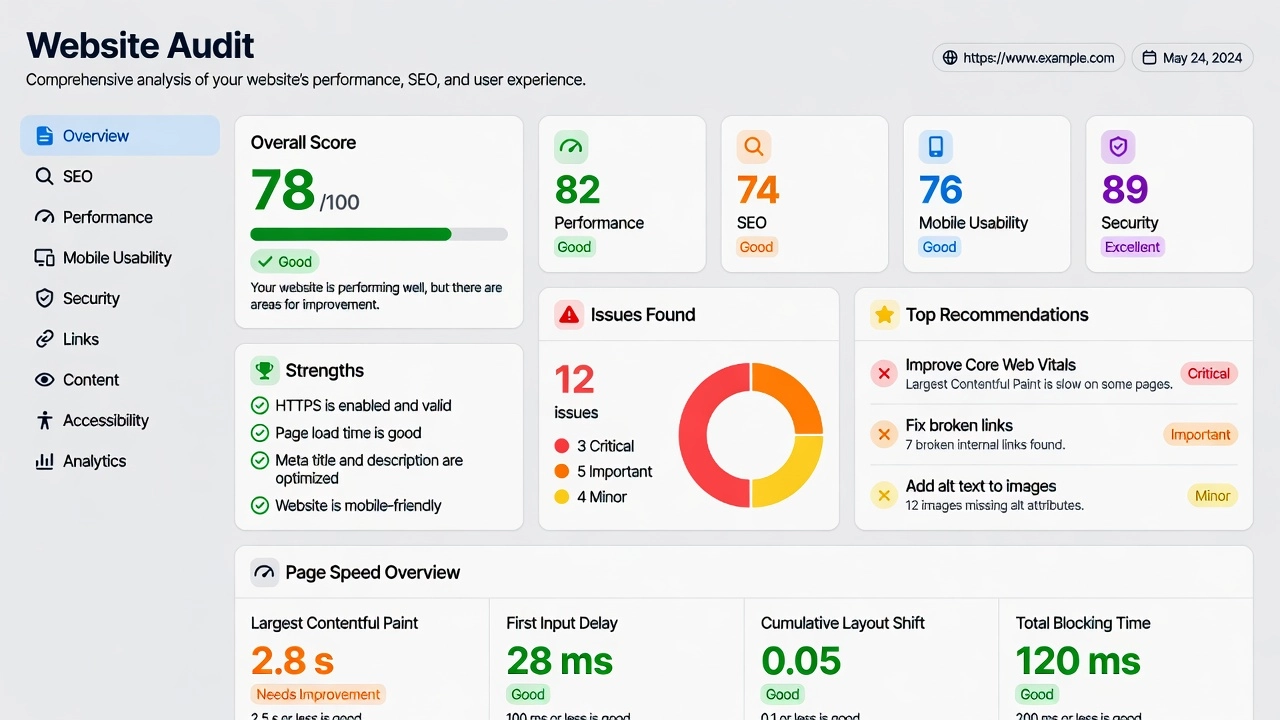
This August we ran 56 real, local business websites from Port St. Lucie to Sebastian through the same 8-point technical check we use on client sites. Restaurants, roofers, salons, law firms, dentists, boat dealers. No names, just numbers. The numbers are worse than we expected, and if you own a business here, some of them are probably about your website.
Everyone in our industry says "most small business websites have problems." Nobody local ever shows the data. So we collected it. We pulled 56 currently active websites belonging to independent Treasure Coast businesses across 12 industries: restaurants, plumbing, salons, law firms, HVAC, dental, auto repair, roofing, day spas, landscaping, marine, and fitness. Every site belongs to a real business in Port St. Lucie, Fort Pierce, Stuart, Jensen Beach, Palm City, Vero Beach, or Sebastian. Then we checked each homepage the same way Google and AI crawlers see it on first pass: the raw HTML, before any fancy scripts run.
We kept the results anonymous on purpose. This isn't about embarrassing anyone, it's about showing local owners what the baseline actually looks like. If you'd rather skip straight to finding out how your own site scores, our free website audit checks everything below and more, with your name on it and nobody else's.
The Headline Numbers
The average site failed 2 of the 8 checks. Fifteen sites, roughly one in four, failed three or more. And one site in our sample still doesn't load over a secure HTTPS connection in 2026, which means browsers literally warn visitors away from it.
Finding 1: One in Five Local Websites Is Nearly Invisible to Crawlers
This was the finding that surprised us most. Eleven of the 56 sites, exactly 20%, returned no page title, no description, no viewport tag, nothing, when fetched the way a search engine or AI crawler first fetches a page. The content only appears after JavaScript runs in a browser.
Why does that matter? Google can eventually render JavaScript, but it does so later, less often, and less reliably than plain HTML. Worse, most AI crawlers, the ones feeding ChatGPT, Perplexity, and the systems behind Google's AI Overviews, largely don't render JavaScript at all. To them, these 11 businesses simply don't exist. As more local buying decisions start with an AI answer instead of ten blue links, "invisible to AI crawlers" stops being a technicality and starts being a lost customer every day.
These weren't abandoned sites. They belong to operating restaurants, salons, plumbers, and landscapers, businesses paying for a website that search engines struggle to read.
Finding 2: The Title Tag, the Easiest Win in SEO, Is Still Being Fumbled
Your homepage title is the single strongest on-page signal you control, and it's the blue link people see in results. Among the 45 sites that had one, 16 titles (36%) ran past 60 characters, the point where Google truncates them mid-sentence. Three more were under 30 characters and wasted the space entirely, saying things like just the business name and nothing else.
The location gap was bigger. 30% of all sites never mention their city or region anywhere in the title. For a local business competing in map packs and "near me" searches, leaving "Port St. Lucie" or "Vero Beach" out of your title is like printing business cards without a phone number. It's the first thing we fix on almost every local SEO engagement, and it costs nothing.
Finding 3: The Basics Are Missing More Often Than You'd Think
| Check | What it does | Sites missing it |
|---|---|---|
| Meta description | Your sales pitch under the blue link in Google | 17 of 56 (30%) |
| Canonical tag | Prevents duplicate-content confusion | 16 of 56 (29%) |
| Social preview tags | Controls how links look when shared or texted | 17 of 56 (30%) |
| Mobile viewport tag | Tells phones how to display the page | 12 of 56 (21%) |
| Tap-to-call phone link | Lets mobile visitors call you in one tap | 19 of 56 (34%) |
The tap-to-call number deserves a special mention. Most local service searches happen on a phone, and the entire point of the visit is usually to call you. One in three sites makes that visitor squint at a phone number and retype it. Some of those are the same sites paying for Google Ads to get that visitor in the first place.
Finding 4: 82% Are Leaving Free Speed on the Table
Only 10 of 56 sites served any images in modern formats like WebP or AVIF, which typically cut image weight by 30% to 70% with zero visible quality loss. Images are the heaviest thing on almost every small business homepage, so this is the cheapest speed upgrade that exists, and 82% of the sample hasn't taken it. Speed isn't cosmetic: it's a ranking input through Core Web Vitals, and it's the difference between a visitor waiting or bouncing on a phone with two bars at the beach.
Who's Getting It Right (and Who Isn't)
The industry patterns were striking. Roofers, HVAC companies, and law firms had the cleanest sites in the sample, averaging under one failed check each. These are the industries where a single customer is worth thousands of dollars and the competition already invests in marketing, so the bar has risen. Meanwhile day spas, dental offices, and landscapers averaged three failed checks per site, and the two plumbing sites we sampled were among the weakest of all 56.
That gap is an opportunity in plain sight. If you're in an industry where the average competitor's website can't even tell Google what city it's in, competent fundamentals alone put you ahead of most of your market. Not clever tricks. Fundamentals.
Platform-wise, WordPress powered 45% of the sample, with the rest split across Wix, Squarespace, GoDaddy, Duda, Shopify, Weebly, and industry-specific builders. Here's the thing: we found well-built and badly-built sites on every platform. The failures above aren't platform failures, they're setup and maintenance failures. Somebody built each of these sites, got paid, and never checked the fundamentals.
What We Checked and How
For transparency: each site's homepage was fetched over HTTPS the way a crawler fetches it, and we evaluated 8 checks: secure HTTPS connection, a page title present, a title of usable length, a location mentioned in the title, a meta description, a mobile viewport tag, a canonical tag, and social preview tags. We also recorded image formats, tap-to-call links, and the platform each site runs on. Sites were selected from public listings across 12 industries and 7 Treasure Coast communities in early August 2026. No client sites of ours were included in the sample, and no business is identified in the data.
What This Means for Your Business
Every check in this audit is fixable in an afternoon by someone who knows what they're doing. None of them require a redesign. That's really the takeaway: the majority of local websites are losing visibility not to hard problems but to unchecked boxes, and the businesses that check them get a head start that compounds every month, in Google and increasingly in AI answers.
We'll rerun this audit with a larger sample and track how the numbers move. If the Treasure Coast average improves, we'll show it. If it doesn't, well, that's useful to know too, especially if your site is on the right side of the gap.
Want to Know How Your Site Scores?
We'll run your website through this full checklist plus speed, security, and local SEO checks, and send you a plain-English report of what's solid and what's costing you customers. Free, no strings, usually within two business days.
Get your free website audit